Cost per tonne known too late
Clinker and cement cost per tonne arrive after period close, after the pricing and production decisions they should have informed.
Cement industry
14+ Years Specialized Experience
SAP and enterprise ERP processes, plant operations, systems integration and analytics — connecting what happens at the crusher, the kiln and the weighbridge to the ledger, the cost sheet and the management report.
Operating challenges
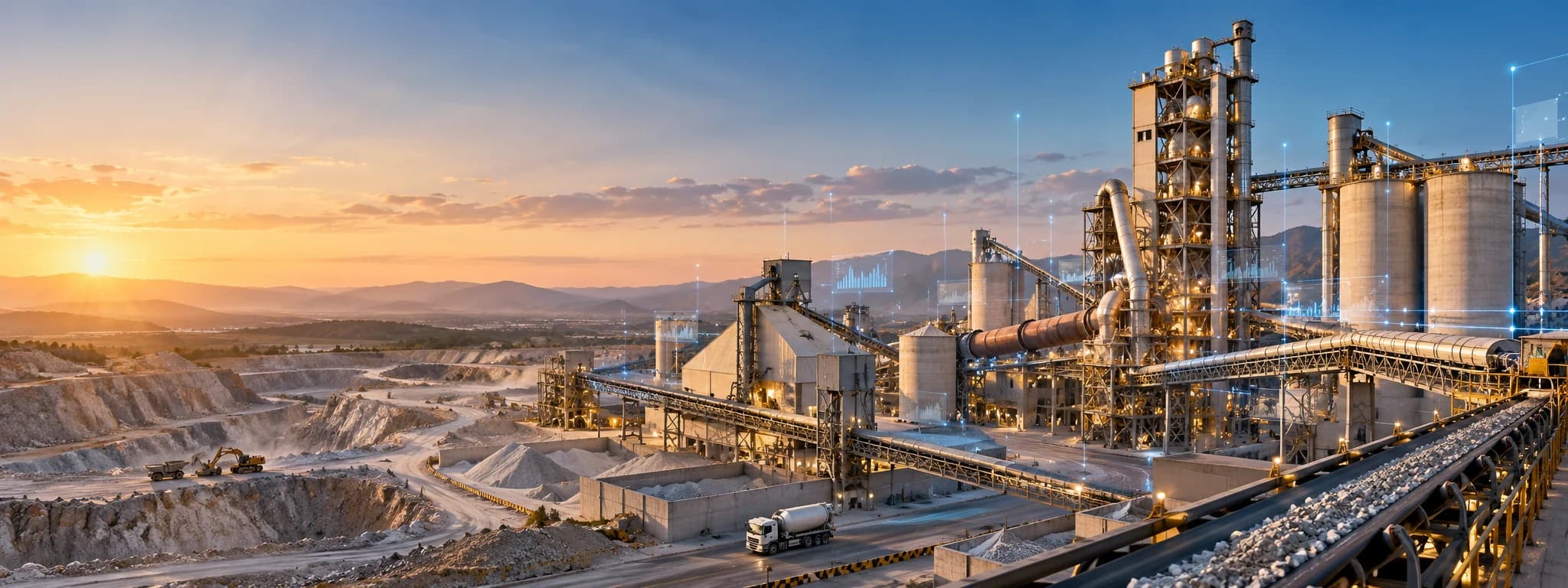
Cement is continuous, energy-intensive and asset-heavy. The plant usually knows what happened; the business systems find out later and less precisely.
Clinker and cement cost per tonne arrive after period close, after the pricing and production decisions they should have informed.
Thermal and electrical energy dominate cost but are booked to the plant as a whole, not to the kiln and mills that use them.
Kiln, mill and crusher history lives with experienced people, so planned maintenance competes with breakdowns.
Yard, silo and system figures diverge between counts, especially for clinker and raw materials.
Weighbridge, delivery and invoicing are reconciled by hand, so credit and stock lag the trucks.
The production lifecycle
Each stage produces operating data and business transactions. Open a stage to see which ones usually matter for planning, costing and maintenance.
Operating data
Business transactions
Operating data
Business transactions
Operating data
Business transactions
Operating data
Business transactions
Operating data
Business transactions
Operating data
Business transactions
Operating data
Business transactions
Operating data
Business transactions
SAP & enterprise ERP
Our team has delivered multiple SAP implementations, including projects in the cement industry.
Cement has an ERP shape of its own: continuous production, energy as a cost driver, heavy maintenance and high-volume dispatch. These are the process domains an SAP or other enterprise ERP programme has to get right in a cement plant.
Plant cost centres, period close and management accounting.
Raw materials, fuel, spare parts and packaging, with stock that matches the yard.
Kilns, mills and crushers maintained against history, not memory.
Process orders, laboratory results and release by cement type.
Orders, credit, deliveries and weighbridge integration.
Clinker cost per tonne and cement cost per tonne, kept separate.
Thermal and electrical energy allocated to the stages that use them.
One set of numbers for operations, finance and management.
SAP, Oracle Fusion and Odoo are named as platforms we work with. Naming a platform does not imply a partnership, certification or endorsement.
Industrial to enterprise
Plant systems and business systems usually run side by side without talking. The integration layer is what lets a kiln stop, an energy reading or a laboratory result reach the ERP and the management report.
Where operating data originates
Collected, validated, contextualised
Recorded as business transactions
Read as decisions
Illustrative plant signals
Cement performance dashboard
A conceptual design. Each card shows the kind of measure a connected cement plant can report — not results from any plant.
Illustrative Demo Data
No figures are shown. Charts are shapes only, not data from any plant or client.
Enterprise processes supported
Demand, production planning and process orders by cement type.
Raw materials, fuel and spares from requisition to payment.
Notifications, work orders and failure history for critical assets.
Orders, credit, dispatch, weighbridge and invoicing.
Laboratory results and release by batch and cement type.
Period close, cost allocation and management accounts.
Operational and executive reporting from one data source.
Plant systems, weighbridges and ERP kept in step.
Practical transformation paths
There is no single roadmap for every cement producer. These are the three starting points we see most often.
Keep the platform, fix the configuration, the process and the adoption gaps that hold it back.
Fits when the platform is sound but under-used.
Connect plant data and reporting to what you already run, without replacing the core system.
Fits when the numbers exist but do not meet.
Replace or extend specific applications and workflows step by step, around the production schedule.
Fits when part of the estate has reached its limit.
Experience
Discovery, selection, implementation, optimization and integration across finance, supply chain and operations — with the platform chosen on fit, never assumed in advance.
APIs, data flows and the continued operation of what has been delivered, under explicit service ownership rather than informal goodwill.
Document, workflow and decision automation applied where the data genuinely supports it — and declined, with reasons, where it does not.
Assessment, operating-model design and a sequenced roadmap, so modernization is absorbed by the organization rather than announced to it.
Start with the operating problem — costing, maintenance, dispatch or reporting — and decide the platform question after.